Designing fair remuneration is one of the hardest parts of a compensation manager’s job. Get it right and you attract talent, retain performers, improve employee satisfaction, and stay defensible under audit. Get it wrong and you lose people, overspend, or face legal exposure.
This guide covers what remuneration includes, how to think about plan design, and the trends shaping compensation decisions in 2026.
What Is Employee Remuneration?
The definition of ‘remuneration’ is the total value an employee receives in exchange for their work, usually defined in the employment agreement. It includes cash pay, variable incentives, benefits, and non-cash perks.
The term is used most often in the UK, EU, and other global HR contexts. In the US, “total compensation” or “total rewards” carries the same meaning. For this guide, treat them as interchangeable.
Types of Remuneration
Direct Remuneration
Direct remuneration is a cash payment to the employee, also called employment income.
- Base salary
- Hourly wages
- Commission
- Bonuses, including discretionary bonus payouts
- Tips
- Stock options, equity grants, and, in some cases, cryptocurrency compensation
Indirect Remuneration
Indirect remuneration is a non-cash value the employee receives, often categorized as fringe benefit value.
- Employee benefits like health, dental, and vision insurance
- Retirement contributions (401(k) match, pension)
- Paid time off, parental leave, sick leave
- Life and disability insurance
- Wellness programs, education stipends, transit benefits
- Perks (company car, phone, gym, meals)
- Equity that has not yet vested
Comp managers often underweigh indirect remuneration when communicating with employees. A total rewards statement that shows the full direct and indirect package usually changes how employees perceive their pay.
How Do You Design a Fair Remuneration Plan?
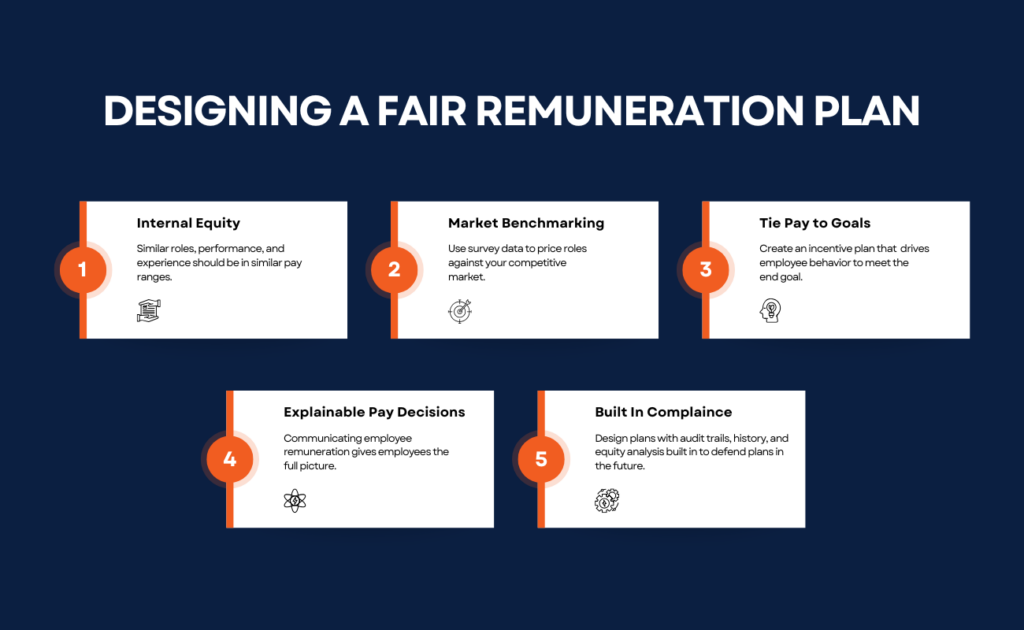
Fair remuneration is not the same as equal remuneration. People in different roles, with different performances, in different markets should be paid differently. Fairness comes from making those differences explainable and defensible. Five principles guide good plan design.
1. Anchor to Internal Equity
People in similar roles with similar performance and experience should land in similar pay ranges. Build a job architecture, set annual salary bands, and apply them consistently. When exceptions happen, document why.
2. Benchmark Against the Market
Use third-party survey data to price roles against your competitive market. Decide whether you want to pay at the median, above, or below, and apply that target consistently. The right benchmark depends on the role, geography, and talent you are competing for.
3. Tie Variable Pay to Outcomes You Want
Variable pay drives behavior. The goal is to create an incentive scheme that leads to the company’s end goal. If your bonus rewards individual revenue but your strategy depends on cross-team collaboration, the plan undercuts the strategy. Audit each variable component and ask whether it reinforces the outcomes the company actually wants.
4. Make Pay Decisions Explainable
Employees do not need to agree with every pay decision, but they need to understand it. Document how ranges are set, how performance ratings translate to merit increases, and how variable pay is calculated. Communicating employee remuneration through total rewards statements gives employees the full picture in one document, which reduces questions to HR.
5. Build for Compliance From the Start
Pay transparency laws and pay equity audits are growing. Plans designed with audit trails, version history, and equity analysis built in are easier to defend than plans cleaned up after the fact. Predictive modeling helps comp teams test plan changes against equity impact before rollout, not after.
If you’re looking for more information on how to design total compensation packages, read our complete guide.
Trends Shaping Remuneration in 2026

Pay transparency legislation is expanding
The EU Pay Transparency Directive, plus state laws in California, Colorado, New York, Washington, and Illinois, require employers to disclose ranges and explain decisions. Build for transparency now, even where it is not yet required.
AI is moving into compensation planning
AI-driven tools are increasingly being used for predictive modeling, scenario planning, and personalized recommendations. The value is in testing plan changes before rollout, not in automating decisions that still need human judgment.
Pay-for-skills is replacing pay-for-tenure in some sectors
Tech, healthcare, and skilled trades are pricing demonstrated capability rather than years in the seat. Comp managers in these sectors need to map skills to pay, not just titles.
Pay equity audits are now ongoing, not one-time
Regulators expect remediation plans and continued monitoring. Tools that track demographic distribution and flag drift are becoming standard.
Total rewards statements are a retention tool
Showing employees the full value of their package, including indirect remuneration they may not see in their paycheck, helps with retention. This is one of the highest-leverage employee communications a comp team produces.
Pay transparency is becoming pay explainability
It is no longer enough to publish ranges. Employees, executives, and regulators want to know how decisions were made. Decusoft has written about this shift if you want to dig deeper.
Frequently Asked Questions about Remuneration

What is the difference between salary and remuneration?
Salary is one component of remuneration. Remuneration includes annual salaries plus variable pay, benefits, equity, and any other value the employee receives.
What is the difference between remuneration and total compensation?
The terms mean the same thing. “Remuneration” is more common in the UK, EU, and global contexts. “Total compensation” or “total rewards” is more common in the US.
What makes executive remuneration different?
Executive remuneration carries a higher proportion of variable and long-term pay, including stock options, RSUs, performance shares, and deferred compensation. It also faces more disclosure requirements, board oversight, and shareholder scrutiny than non-executive remuneration.
How does remuneration affect taxes?
Different components are taxed differently within the tax year they are received. Salary and most cash bonuses are taxed as ordinary income tax. Equity is taxed based on grant type and timing. Some benefits are tax-advantaged (retirement contributions, certain health benefits). Employees should consult a tax professional for guidance on their specific situation.
What is the difference between fixed and variable pay?
Fixed pay is guaranteed. It includes base salary and allowances. Variable pay is tied to performance, whether individual, team, or company.
The mix between fixed and variable shifts by role. A customer service representative might sit at 95/5 fixed-to-variable. A senior sales representative might run 50/50, or even 40/60. Plan design decisions about this mix signal what the company values and how much risk it expects employees to carry.
What legal frameworks relate to pay transparency?
As pay transparency laws and pay equity audits are growing, several frameworks shape an employer’s obligation to disclose and contribute today:
- Pay disclosure: The EU Pay Transparency Directive (effective June 2026), US state pay transparency laws, and UK gender pay gap reporting all require employers to publish pay ranges or pay gap data.
- Equal pay law: The US Equal Pay Act, the EU equal pay principle, and the UK Equality Act require equal pay for equal work or work of equal value.
- Wage and hour rules: The Fair Labor Standards Act and EU/UK national wage laws set minimum wage, overtime, and working time floors that vary by jurisdiction.
- Employer contributions: Mandatory contributions to Social Security, Medicare, ERISA-governed plans, ACA coverage, and UK auto-enrollment pensions sit alongside direct pay and belong in total rewards statements.
Build Remuneration Plans You Can Defend

Most comp teams know what fair remuneration looks like in theory. The hard part is operating it. Spreadsheets break under the weight of multiple plan types. Total rewards statements get built manually every cycle. Pay equity analysis happens after a problem is flagged, not before.
Compose changes that. Comp managers use the platform to design, model, and deliver remuneration programs in one place, with the audit trails, transparency, and predictive modeling that today’s compensation environment requires.
Schedule a demo, and we will walk through your specific program.