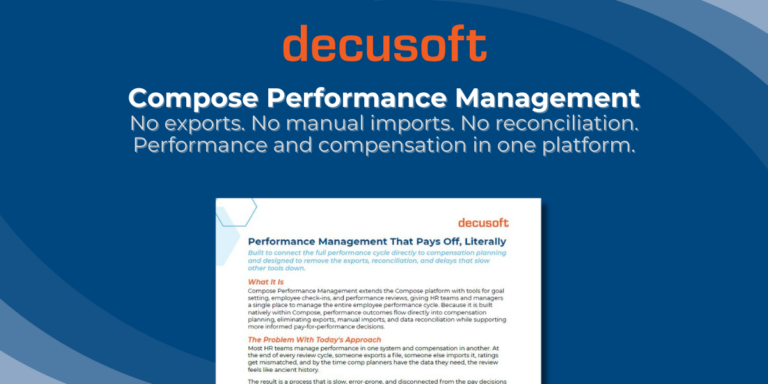
Compose Performance Management Product Brief
No exports. No manual imports. No reconciliation. When performance and compensation share a platform, ratings reach your pay decisions the moment reviews are submitted.

No exports. No manual imports. No reconciliation. When performance and compensation share a platform, ratings reach your pay decisions the moment reviews are submitted.
No exports. No manual imports. No reconciliation. When performance and compensation share a platform, ratings reach your pay decisions the moment reviews are submitted.

Decusoft partners with MorganHR to help helps organizations identify the right-fit compensation planning solution based on company size, program complexity, and stage of growth.
Organizations typically manage performance and compensation as two
separate disciplines. Employees experience them as a single promise. The
gap between the two is quietly costing organizations more than they realize.
This guide was written for CFOs and senior finance leaders who are ready to close that gap. It covers what compensation intelligence actually means in financial terms, what the status quo is costing your organization, and what modern compensation infrastructure should be able to do.
As compensation has become a board-level topic tied to pay equity mandates, retention risk, and cost discipline, the gap between system capability and business expectation has widened.
As compensation has become a board-level topic tied to pay equity mandates, retention risk, and cost discipline, the gap between system capability and business expectation has widened.
Decusoft partners with Trusaic to strengthen support for data-driven, equitable compensation programs and global pay transparency compliance.

Most organizations have made real progress on pay transparency. Salary ranges are posted. Frameworks are documented. Compliance boxes are checked.
But there’s a harder question emerging, one that employees, executives, and regulators are starting to ask:
Two landmark AI innovations, conversational data intelligence and predictive scenario modeling, establish Decusoft as the definitive leader in intelligent enterprise