Short answer: Total compensation is the complete value of everything an employee receives in exchange for their work, including their base salary, bonuses, benefits package, equity, retirement contributions, and other perks that extend beyond a standard paycheck. For most organizations, this represents their single largest operating expense, making it one of the most consequential areas of financial planning and people strategy.
Understanding total compensation in full is not just a human resources exercise. It is a business imperative that shapes how organizations attract talent, manage costs, and retain the people who drive results.
What’s Included in Total Compensation?
First, what is total compensation?
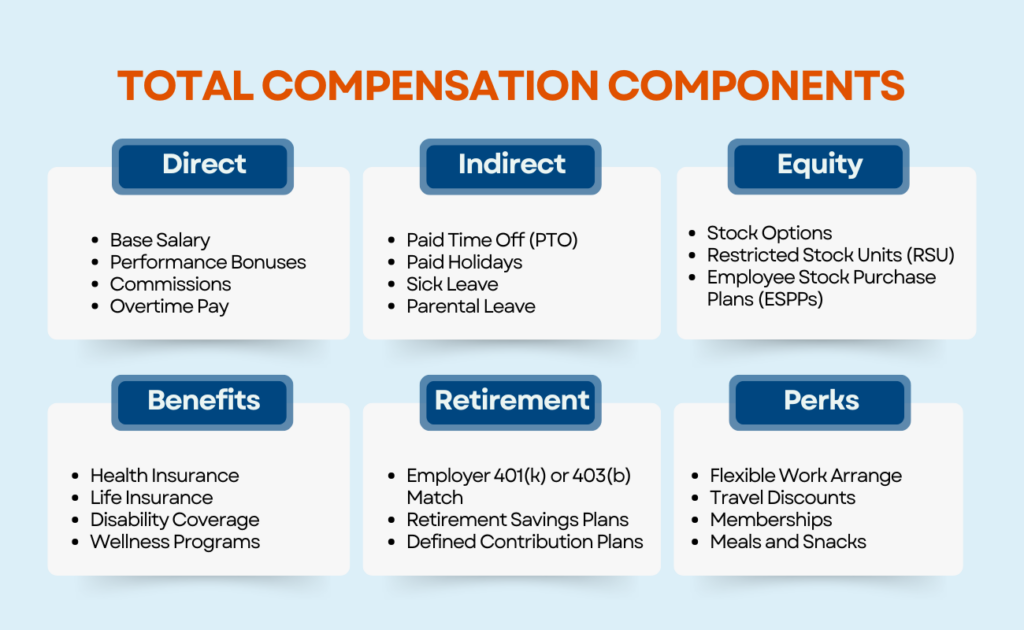
Total compensation encompasses everything an employee receives in exchange for their work. It goes beyond base salary to include the full value of direct pay, benefits, equity, and additional perks that together make up an employee’s complete rewards package. Understanding each component is the first step toward building a compensation plan that is both competitive and sustainable.
Direct Compensation
Direct compensation is the monetary pay an employee receives in exchange for their work, whether structured as a cash payment, salary, hourly rate, or commission. It is the most visible element of a total compensation package, and typically the primary factor prospective employees consider when evaluating a job offer.
Common Direct Compensation Models
Organizations structure direct compensation in a variety of ways depending on their industry, workforce, and business goals. The most common models include:
- Salary — A fixed annual or monthly pay rate regardless of hours worked or output
- Salary Plus Commission — An annual base salary supplemented by earnings tied to sales performance
- Hourly Rate — Pay calculated by the hour, at or above minimum wage
- Hourly Rate Plus Commission — An hourly base combined with sales-based incentive pay
- Commission Only — Compensation earned entirely through sales performance with no base pay
- Territory Volume — Commission split among a team based on total sales within a geographic territory
- Profit Margin or Revenue-Based — Pay tied directly to the profitability or revenue generated by the employee or team
- Residual Commission — Ongoing earnings from accounts or clients that a current employee previously closed
- Contractor Commission — Performance-based pay structured for independent contractors
Indirect Compensation and Benefits
Indirect compensation refers to the non-cash value an organization provides to employees outside of their direct pay. These benefits are typically structured around employment status, with full-time employees receiving a more comprehensive package than their part-time counterparts.
Common indirect compensation components include health plans, retirement plans, paid time off, sick leave, life insurance, and overtime pay, typically available to benefits-eligible employees based on their employment classification.
Equity
Equity compensation gives employees an ownership stake in the company, typically in the form of stock options, restricted stock units, or profit sharing. For many organizations, equity helps align employee interests with long-term business performance and for competing for top talent in markets where base salary alone may not be sufficient.
Perks and Additional Benefits
Perks are the additional offerings that go beyond standard benefits and direct pay. While they may seem secondary, perks play an increasingly important role in how employees perceive the value of their employment.
Examples include remote work flexibility, wellness programs, employee assistance programs, training programs, professional development stipends, and lifestyle benefits.
Why Total Compensation Matters
For Employees – For a professional employee evaluating a job offer or negotiating a raise, understanding total compensation provides a clearer and more complete picture of their true earning value beyond their base paycheck. It also provides a stronger foundation for salary negotiations and long-term career decisions.
For Employers – Communicating total compensation effectively helps organizations attract prospective employees and retain current staff by showing the full picture of what the company invests in them, not just what appears on a pay stub. Organizations can also use a total compensation estimator to help prospective candidates and employees understand the complete value of their rewards package at a glance, making it a powerful tool during recruiting and annual review conversations.
Compensation Eligibility and Regulations by Employee Type

Not all employees receive the same compensation structure, and understanding the distinctions is an important part of building a compliant and equitable total rewards strategy.
Full-Time vs. Part-Time Employees
Full time employees typically qualify for a broader range of benefits, including health plans, retirement contributions, paid sick leave, and access to equity programs. Part time employees may have limited or no access to these benefits, depending on the organization’s policies and applicable state or local regulations. HR and finance leaders should clearly define eligibility thresholds and communicate specific options available to each employee classification to avoid confusion and ensure compliance.
Contractors vs. Full-Time Employees
Independent contractors are not entitled to the same benefits package as full time staff employees and are responsible for their own taxes and insurance. Organizations that misclassify employees as contractors face significant legal and financial exposure. Clear classification policies and regular audits of worker status are essential for organizations that rely on a blended workforce.
Exempt vs. Non-Exempt Employees
Under the Fair Labor Standards Act, employees are classified as either exempt or non-exempt, which determines their eligibility for overtime pay. Non-exempt employees must be paid overtime for hours worked beyond 40 in a workweek, while exempt employees, typically salaried professionals meeting specific salary and duties thresholds, are not entitled to overtime. Misclassification in this area is one of the most common and costly compliance errors organizations make.
*Disclaimer: These regulations will vary by country and state. Please consult a legal professional for details regarding your business.
Trends in Total Compensation Management
Total compensation strategy is no longer a static, annual exercise. The organizations that attract and retain the best people are the ones that treat compensation as a living, evolving component of their broader business strategy. Here are the key trends shaping how HR and finance leaders approach total rewards today.
Pay Transparency
Business priorities have shifted considerably in recent years. While staff growth, cost control, and operational efficiency remain essential, executives are increasingly focused on agility, enterprise-wide integration, and transparency as competitive differentiators. Pay transparency is at the center of this shift. Employees and candidates now expect to understand not just what they earn, but how pay decisions are made and how their compensation compares within the organization. This expectation is being reinforced by a growing number of state and local pay transparency laws requiring employers to disclose salary ranges in job postings. Organizations that proactively embrace transparency are better positioned to build trust, reduce pay inequities, and compete for talent in an increasingly informed labor market.
Employee Involvement and Engagement
Employee engagement has become a foundational element of effective compensation strategy. Organizations are recognizing that compensation decisions made in isolation, without employee input or visibility, tend to erode trust and increase turnover. There is now a broader understanding that high-performing businesses do not operate in functional silos. They encourage collaboration toward shared goals and align compensation philosophy with those objectives. Many companies have evolved their approach to total rewards in recent years to reflect this shift, moving from top-down pay decisions to more transparent, participatory models that give employees a clearer sense of how their contributions are recognized and rewarded. Because compensation accounts for 70% or more of a traditional organization’s operational budget, this alignment between workforce expectations and organizational goals has never been more important.
Flexibility and Work-Life Balance
Flexibility has moved from a perk to an expectation, particularly among younger workers. According to a Deloitte survey, more than 75% of millennials and Gen Z employees rank work-life balance as one of their top priorities when evaluating a job offer, ahead of salary in many cases. Organizations that incorporate flexibility into their total compensation strategy, through remote or hybrid work options, flexible scheduling, mental health days, and wellness benefits, are seeing stronger engagement and lower attrition rates. For HR and finance leaders, this means the definition of competitive compensation now extends well beyond the paycheck.
Personalization of Total Rewards
A one-size-fits-all compensation package is increasingly ineffective in a workforce that spans multiple generations with varying priorities. Younger employees may prioritize student loan repayment assistance and flexible work arrangements, while more tenured employees may place greater value on retirement contributions and healthcare coverage. Leading organizations are beginning to offer more modular or flexible benefits structures that allow employees to direct a portion of their rewards toward the areas that matter most to them. This personalization not only improves perceived compensation value but also reduces the cost of offering benefits that go unused.
Pay Equity and Compliance
Pay equity has moved from a reputational concern to a legal and regulatory priority. An increasing number of jurisdictions now require employers to conduct and document regular pay equity analyses, and employees are more willing than ever to discuss compensation openly with their colleagues. Organizations that take a proactive approach to identifying and addressing pay gaps, rather than waiting for complaints or audits, are better protected from legal exposure and better positioned to build a culture of fairness and inclusion.
Total Rewards Communication
Even the most competitive compensation package loses its impact if employees do not fully understand what they are receiving. Research consistently shows that employees underestimate the value of their benefits by a significant margin, which means organizations are leaving a meaningful retention and engagement tool on the table. A growing trend among forward-thinking HR teams is the shift toward automated, personalized total rewards statements that give employees a clear, comprehensive view of everything the organization invests in them, from salary and bonuses to benefits, equity, and perks.
What are the key factors impacting organizational success?
Cost of Collaboration
Compensation planning is rarely a single-department effort. HR, finance, banking partners, and line managers across the business all play a role in reaching final compensation decisions, and the time and coordination required to align those stakeholders carries a real cost. When collaboration is inefficient, whether due to disconnected systems, manual handoffs, or unclear workflows, it slows down decision-making and introduces the risk of inconsistencies across the organization. Streamlining how these teams work together is one of the most overlooked levers for improving compensation outcomes.
Effective Compensation Tools
The tools an organization uses to manage compensation directly shape the quality of its decisions. Modern compensation platforms provide more cohesive auditing, monitoring, and modeling capabilities than legacy systems or manual processes can offer. When HR and finance leaders have access to real-time data, configurable models, and explainable outputs, they are better equipped to make decisions that are accurate, consistent, and aligned with business objectives. The right compensation tool does not just automate tasks. It elevates the quality of the entire planning process.
Issues and Risks of Spreadsheets
Only 17% of companies that use spreadsheets have no estimation or payout errors; on the other hand, 83% of people who use Excel for variable payments have reported calculation errors. For an area of the business as consequential as compensation, where errors affect employee trust, retention, and compliance, this error rate represents a significant and largely avoidable risk. Organizations that have moved away from spreadsheet-based processes consistently report greater accuracy, faster cycle times, and stronger confidence in their compensation data.
The Importance of Total Compensation Strategy, Planning, and Management

A competitive total compensation package means little without the operational infrastructure to plan, manage, and execute it effectively. For HR and finance leaders, total compensation management is not a seasonal task confined to a four-to-six week review window. It is a year-round process that involves updating compensation standards, onboarding new employees at appropriate pay levels, adjusting to market shifts, and moving toward more variable compensation models as business needs evolve. The complexity of this process, combined with the scale of the compensation budget, makes the tools and systems behind it just as important as the strategy itself.
The Case Against Spreadsheets
Despite the availability of purpose-built compensation platforms, many organizations still rely on spreadsheets to manage their compensation processes. The consequences of this approach are well documented. Companies that depend on spreadsheets for compensation management report more time spent on manual tasks, higher rates of calculation errors, fewer defensible decisions, and lower overall process performance. Much of this is driven by the operational habits that spreadsheet use encourages, such as copying and pasting data across multiple files, and the absence of a centralized view of all the data sources that should inform compensation decisions. When 83% of organizations using spreadsheets for variable pay report calculation errors, the risk to employee trust, compliance, and retention is clear.
Building a Compensation Program That Works Year-Round
Effective compensation management requires cross-departmental coordination between human resources, finance, and business line managers, along with the ability to balance people’s goals with broader organizational objectives. Compensation preparation, review, and decision-making must be supported by systems that allow for real-time adjustments, consistent data access, and defensible outputs at every stage of the process. Organizations that treat compensation planning as a continuous, strategic function rather than a reactive, periodic exercise are better positioned to respond to market changes, reduce pay inequities, and retain the people who drive business results.
How Decusoft Supports Your Compensation Operations
Decusoft’s Compose platform is purpose-built to meet the challenges, complexity, and nuance of enterprise compensation management. By replacing disconnected spreadsheets and manual processes with a centralized, intelligent platform, Compose gives CFOs and HR leaders reliable access to the data they need to make confident, accurate compensation decisions at any point in the year. From configurable prediction models and real-time market insights to fully auditable results and automated employee communications, Compose transforms compensation management from an operational burden into a strategic advantage. Organizations that deploy the right technology for total compensation are better positioned to achieve their human capital goals, move faster in response to changing market conditions, and build a compensation plan that works for their people and their business.
Frequently Asked Questions About Total Compensation
What is the difference between total compensation and total rewards?
Total compensation typically refers to the quantifiable monetary and benefits value an employee receives, including salary, bonuses, equity, and benefits. Total rewards is a broader term that also encompasses non-monetary factors such as career development opportunities, workplace culture, recognition, and work-life balance. Both concepts are important, but total rewards takes a more holistic view of what an organization offers its people.
How do you calculate total compensation for an employee?
To calculate total compensation, start with an employee’s base salary or wages and add the estimated value of all additional components they receive, including employer contributions to health plans, retirement accounts, paid time off, sick leave, bonuses, equity, and any other perks or employee assistance programs. A total compensation estimator can simplify this process by automatically aggregating all components into a single, easy-to-understand figure for each employee.
How often should a compensation plan be reviewed?
A compensation plan should be reviewed at least annually, but leading organizations treat it as a continuous process. Market conditions, hiring activity, inflation, and changes in workforce composition can all affect whether your compensation plan remains competitive and equitable throughout the year. Off-cycle reviews are particularly important when market data shifts significantly or when retention becomes a concern in specific roles or departments.
How does total compensation differ for full time versus part time employees?
Full-time employees typically have access to a broader range of benefits, including health plans, retirement contributions, paid sick leave, and equity programs. Part-time employees may have limited eligibility depending on the organization’s policies and applicable regulations. HR and finance leaders should clearly define which benefits-eligible employees qualify for each component of the package and communicate those specific options clearly to avoid confusion and ensure compliance.
What questions should HR leaders be asking when evaluating their total compensation strategy?
HR and finance leaders evaluating their total compensation strategy should be asking whether their compensation plan is competitive with the current market, whether pay decisions are consistent and defensible across the organization, whether employees understand the full value of their total compensation, whether their current tools support accurate and efficient compensation management, and whether their strategy is flexible enough to adapt to changing workforce expectations and regulatory requirements.