Most performance reviews and the pay decisions that follow them run on two separate tracks. A manager writes a review in one place, and weeks or months later someone sets merit increases and bonuses using numbers that rarely point back to it. Good work goes unrewarded, weak work slips through, and employees stop believing their rating has anything to do with their pay.
An effective performance review that informs pay starts long before the meeting. It rests on goals set at the beginning of the cycle, feedback shared throughout the year, and evidence a manager can point to instead of a memory of the last few weeks. When that record lives in the same system used for compensation, pay decisions become easier to make and easier to defend.
The gap between reviews and pay is fixable, and it helps to know why it opens in the first place.
Why Performance Reviews Often Fail to Inform Pay
The traditional annual review has a timing problem and a memory problem. Managers try to compress a full year into one annual performance review, and recent events crowd out everything that happened earlier. That recency bias means a strong first half can disappear behind a rough final month, and the rating that drives pay reflects timing more than actual job performance.
Employees notice. Only 14% of employees strongly agree that the performance reviews they receive inspire them to improve, and fewer than a third see them as fair or accurate. The disconnect is common enough that traditional performance appraisals have been abandoned by more than a third of U.S. companies in favor of more frequent conversations. When the review process is backward-looking and infrequent, it cannot carry the weight of a pay decision.
What a Performance Review That Informs Pay Looks Like
An effective performance review does three things a standard write-up often skips. Each one makes the final rating something a compensation decision can actually rest on.
It connects to goals set at the start
A useful performance evaluation measures progress against goals both sides agreed to at the beginning of the cycle. Goal setting up front gives the review a clear reference point, so the conversation covers measurable goals and results rather than opinion. Tying individual work to the team’s strategic goals also shows each team member how their work matters. Decusoft’s guide to strategic performance management walks through that alignment in more detail.
It relies on evidence, not recency
A review that informs pay points to specific examples: completed goals, project outcomes, peer input, and performance metrics gathered across the whole period. Concrete evidence keeps the employee evaluation grounded and makes the rating easier to explain when it feeds a merit or bonus decision. Documented specific examples also protect against bias, since the manager works from a record rather than a recent impression.
It shares a record with compensation
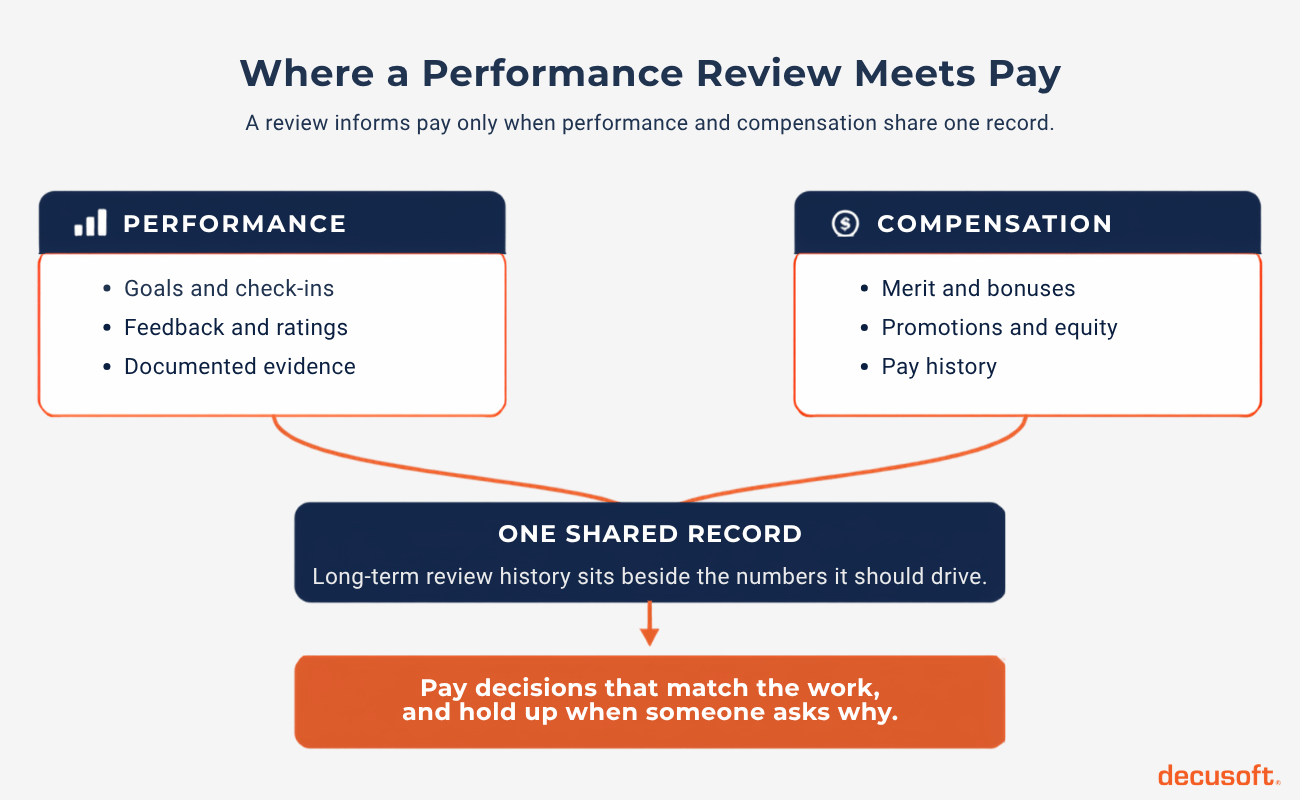
The last piece is connection. When review ratings and check-in notes live in the same system as pay, the person setting compensation sees the same employee performance review the manager wrote. Merit increases, bonuses, and promotions all draw from one source, which is what separates a review that shapes pay from one that gets filed and forgotten.
5 Steps to Conducting Performance Reviews
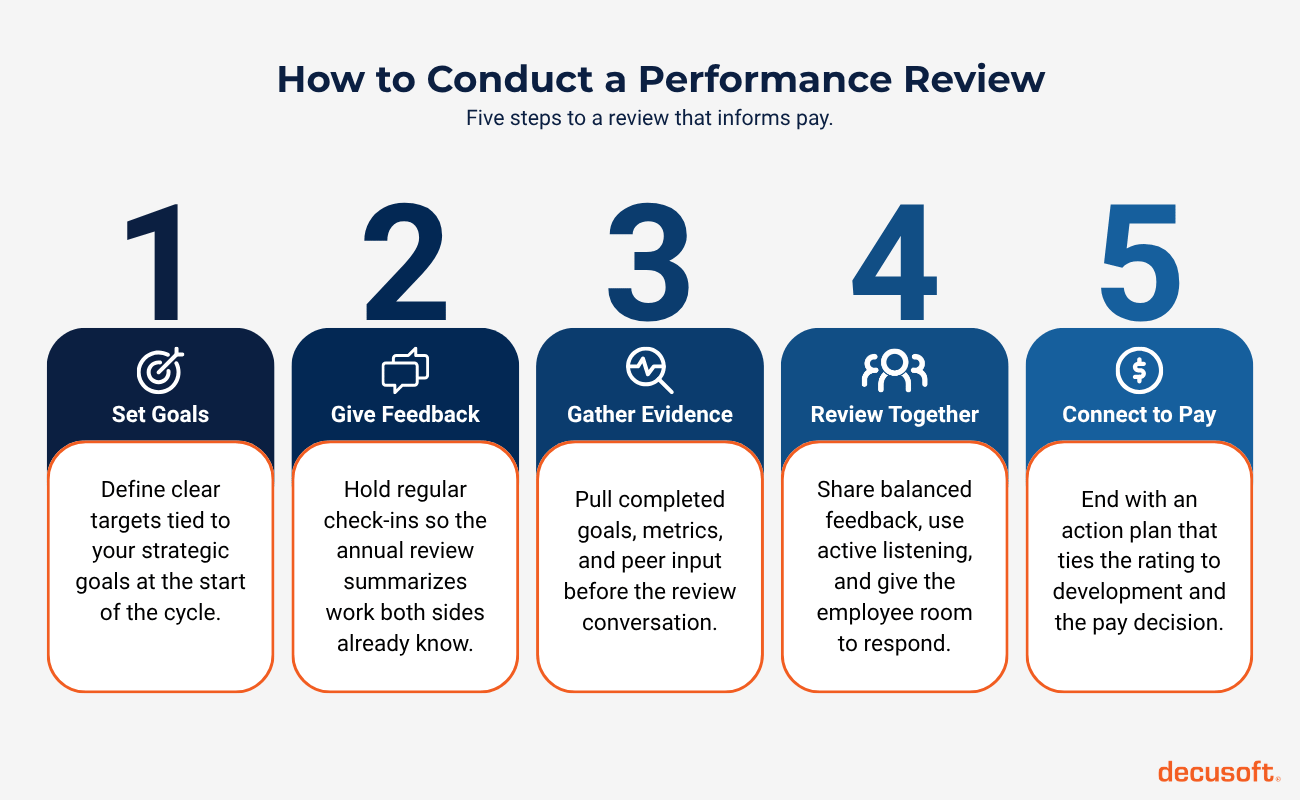
A repeatable performance review process keeps reviews consistent across managers and makes the results usable for pay. These steps turn the review from a once-a-year scramble into a summary of work both sides already recognize.
- Start each cycle with clear, measurable goals tied to the role and to the company’s strategic goals. When targets are specific, the review has something concrete to measure, and each team member knows what strong performance looks like before the period ends. Adding a few long-term goals gives the conversation a horizon beyond the current cycle.
- Give regular feedback throughout the year instead of saving it for one meeting. Employees are far more engaged when they receive feedback from a manager a few times a week or more, and continuous feedback means the annual review holds no surprises. Regular check-ins also mean constructive feedback lands when it still matters, and they build the record you will need at pay time.
- Gather evidence before the review. Pull completed goals, project results, peer input, and performance metrics so the conversation rests on specific examples rather than recent memory. This step is what makes the rating defensible when it informs a bonus or merit increase.
- Run the review as a two-way conversation. Share positive feedback and negative feedback with equal care, keep the tone constructive, use active listening, and give the direct report room to respond. A two-way conversation surfaces context a one-way rating would miss and keeps the employee invested in the outcome.
- Close with an action plan tied to development and pay. Agree on next steps for professional development, note where career development, long-term goals, or a raise fits, and connect the rating to the compensation decision that follows. An action plan turns the review into forward motion instead of a backward-looking grade.
Not every review needs the same weight. A workable rhythm often looks like this:
- Weekly or biweekly check-ins handle quick feedback and small course corrections.
- Quarterly reviews measure progress against goals and reset priorities for the next stretch.
- The annual performance review pulls the year together into a summary rating that informs pay.
Gallup also recommends progress reviews at least every six months, and many teams find quarterly reviews land in the right range.
Best Practices for Connecting Reviews to Pay
A few best practice habits keep the performance review process aligned with compensation and protect it from the problems that make reviews feel arbitrary.
- Calibrate ratings across managers, a best practice that keeps two employees doing similar work on the same scale and pay decisions fair across every direct report.
- Document specific examples throughout the year rather than reconstructing them at review time. A running record fights recency bias and gives high-performing employees credit for sustained work.
- Let performance data, not the loudest recent event, drive the rating. Grounding employee performance in real numbers inside your reporting and analytics supports continuous improvement, professional development, and flags performance issues early so managers can address issues before they grow.
- Be transparent about how ratings map to pay. When employees have a clear understanding of the link between their employee evaluation and their compensation, employee engagement rises and trust in the review process grows.
- Track performance across multiple cycles. One review shows a moment, but several years of employee reviews show whether strong results are a pattern worth rewarding, which is where compensation planning and review history need to meet.

Bring Performance and Pay Together with Decusoft
A performance review only informs pay when the two share a record. When goals, check-ins, and ratings sit in the same platform as your compensation planning, the person setting merit and bonuses sees the same story the manager wrote, and the decision that follows gets sharper and easier to defend.
That is the idea behind Compose Performance Management, a complete toolset for goals, check-ins, and reviews that lives on the same platform Decusoft already uses for compensation. Performance data flows straight into pay decisions, so review history becomes a powerful tool for rewarding the right people and guiding employee development. See how it fits your team, or reach out to a compensation specialist to talk through what you need.