Most companies still run performance management the way they did twenty years ago. Managers write annual reviews, ratings go into a folder, and pay decisions happen months later based on whatever anyone still remembers, which means hard work often goes unrewarded.
Strategic performance management closes that gap by treating employee performance as an ongoing conversation tied to strategic objectives, and by giving HR and finance leaders the data they need to make better decisions about pay, promotion, and professional development.
This guide covers what it is, the components that make it work, how to build a framework around it, and the trends shaping how organizations approach it now.

What Is Strategic Performance Management?
Strategic performance management is a systematic approach to measuring and improving employee performance in ways that support the organization’s strategic priorities. It aligns individual work with business goals, tracks progress against defined key performance indicators, and creates a feedback loop that runs throughout the year rather than once at review time.
The difference from traditional performance management is intent. Traditional versions measure what happened. The strategic approach measures what needs to happen, why it matters, and connects that information to the strategic decisions that follow.
The Core Components of an Effective Framework
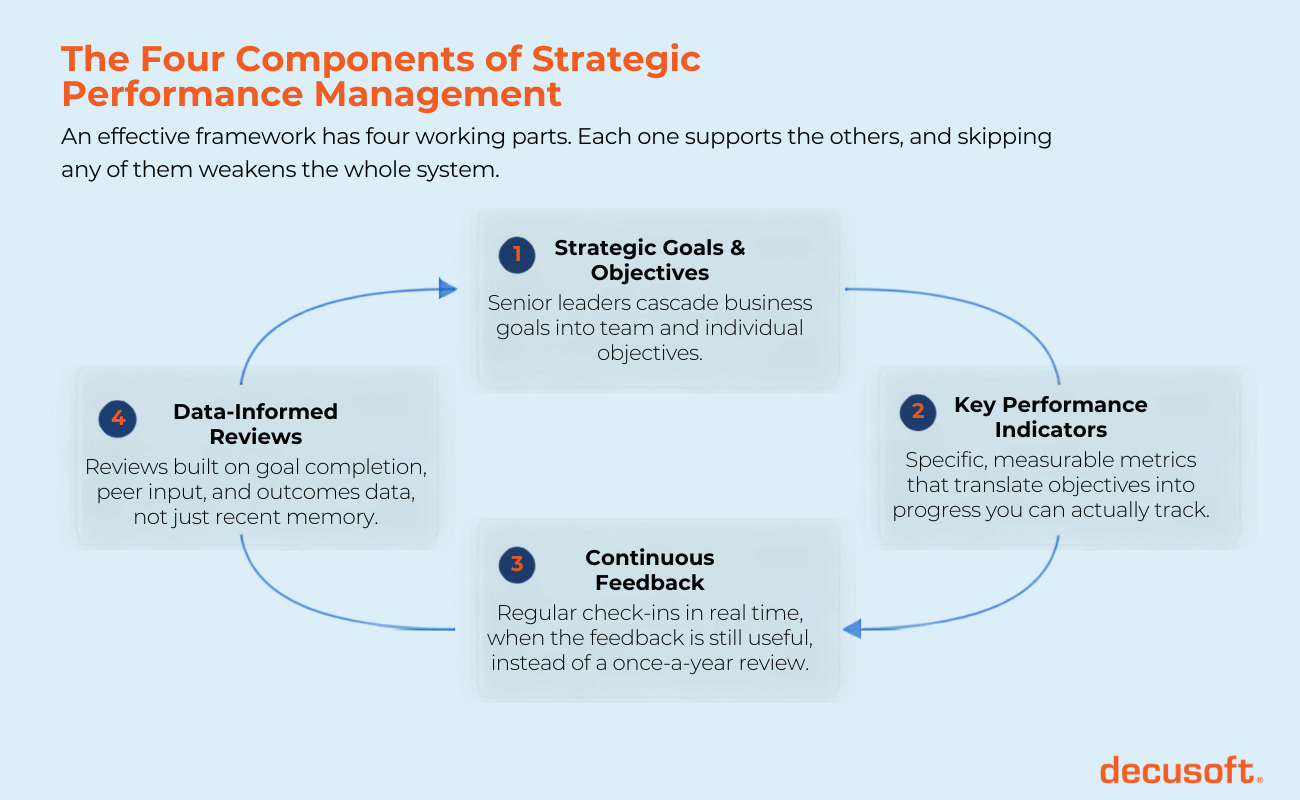
Strategic Goals and Objectives
Strategic goals start at the top and cascade down. Senior leaders set business goals for the year, translate them into strategic initiatives, and connect those initiatives to team and individual strategic objectives. When employees can see how their work supports organizational goals, performance conversations become easier and more useful.
Key Performance Indicators
Key performance indicators turn objectives into something you can measure. Good performance indicators are specific, tied to outcomes the company actually cares about, and reviewed often enough to matter. Many organizations use a balanced scorecard to track financial, customer, operational, and learning metrics together, which keeps any one dimension from crowding out the others.
Continuous Feedback
Continuous feedback supplements the once-a-year review cycle with regular check-ins between managers and employees. That does not mean paperwork every week. It means constructive feedback happens in real time, when it is still useful, rather than months after the fact. Gallup research on employee engagement consistently finds that employees who receive meaningful feedback a few times per week are significantly more engaged than those who receive it once a year.
Data-Informed Reviews
Performance reviews should draw on data that already exists. Goal completion, peer input, project outcomes, and customer satisfaction scores all belong in the review, not just the manager’s memory of the last three months. When performance data flows into the same reporting process that drives compensation, and senior leaders can see it in real time, review outcomes carry more weight and are easier to defend.
How Do You Build a Performance Management Framework?
Building a framework is where most organizations get stuck. The concept is straightforward, but the practical implementation takes intent, strategic planning, and a structured approach. Five principles guide the work.
1. Anchor Every Goal to Business Strategy
Every individual goal should trace back to a strategic objective the company is trying to achieve. If a goal cannot be linked to something the business actually needs, it does not belong in the strategic plan. This is the difference between busywork and meaningful work, and it is the foundation of any real total rewards strategy.
2. Use SMART Goals and Clear Metrics
Vague goals produce vague reviews. SMART goals give both employees and managers something concrete to work against, and pairing each goal with a metric makes the review conversation about progress rather than opinion. The Harvard Business Review has documented the wider shift from annual appraisals toward more frequent, development-focused conversations that produce higher performance.
3. Supplement Annual Reviews With Continuous Feedback
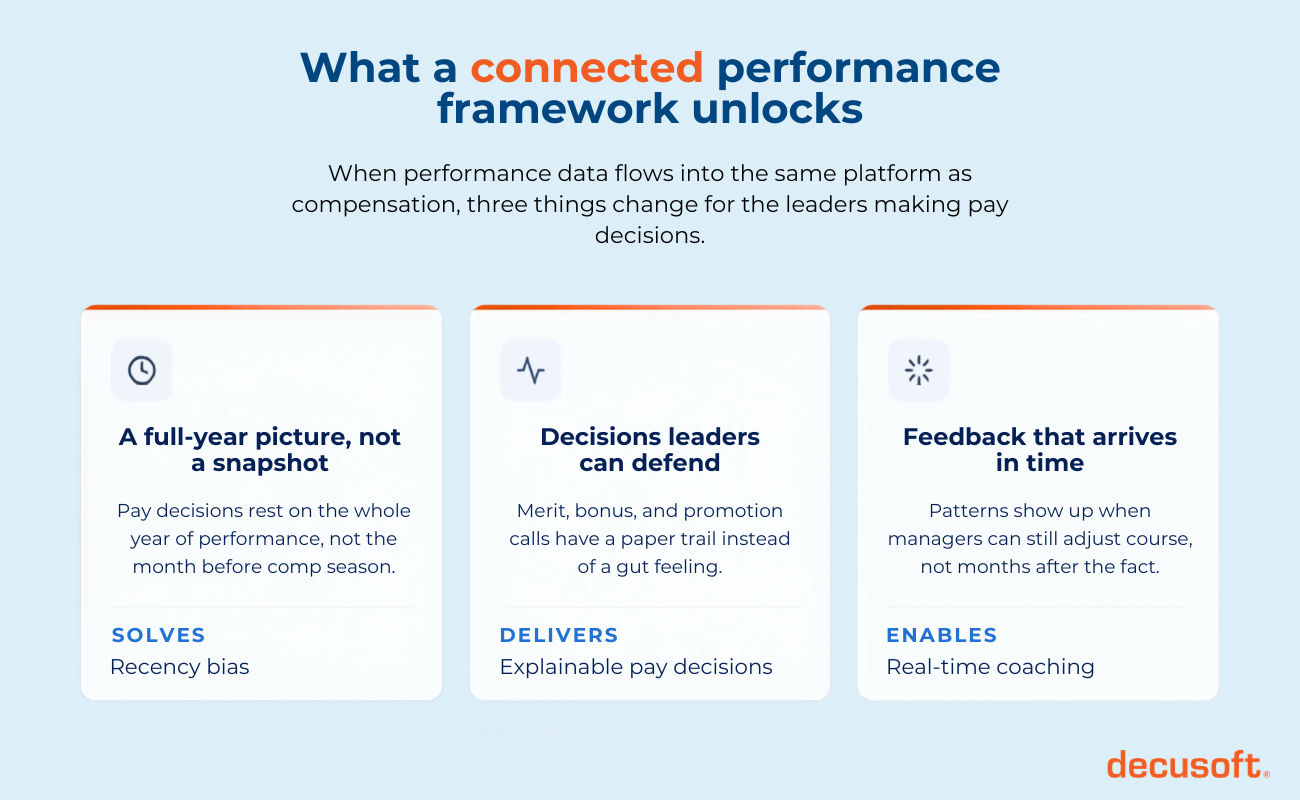
The annual review still has a job to do, but it should not be the only conversation. Managers should be having feedback conversations throughout the year, so the formal review summarizes a record both sides already recognize rather than introducing issues for the first time. Regular feedback also produces better data for compensation decisions, since patterns show up before they become problems.
4. Connect Performance Data to the Decisions That Follow
Performance data is only useful if it informs the decisions that come after. Merit increases, bonus payouts, promotion decisions, and professional development plans should all draw from the same performance record. When performance and compensation planning live in disconnected systems, employees can end up rewarded for average work, or overlooked for strong work, because the person making the pay decision does not see the same data as the person who ran the review.
5. Build for Continuous Improvement
A performance management system should get better over time. Track what is working, adjust what is not, and treat the process itself as something that needs regular tuning. Many organizations review their process every one to two years and adjust based on what the data shows. Case study research from Deloitte’s Global Human Capital Trends reinforces this point: a systematic approach to continuous improvement is what separates organizations that see results from those still running the same broken process year after year.
Trends Shaping Performance Management
Continuous feedback is filling the gaps between reviews.
More organizations in the United States are moving to monthly or quarterly check-ins as the default, with the formal review serving as a summary. Case study analysis from major consultancies points to this shift as one of the most consistent changes in the field, and companies that make the change earn a real competitive advantage in retention.
Performance and compensation data are being connected.
Companies are moving away from siloed performance management systems where the review lives in one tool and the compensation record lives in another. When both share data cleanly, senior leaders can make sharper strategic decisions about how to reward high performance and drive organizational success.
Skills and outcomes are outweighing tenure.
Pay-for-skills and pay-for-outcomes models are gaining ground in tech, healthcare, and skilled trades. Strategic performance frameworks in these sectors focus on demonstrated capability rather than years in the role, which drives operational efficiency and improves service delivery.
AI is entering performance analytics.
AI tools are being used to spot patterns in performance data, flag inconsistencies, and support scenario planning. Compose Insights applies this inside the compensation record itself, surfacing pay outliers and modeling budget scenarios before decisions are finalized. Best practice organizations treat AI as a support layer for managers, not a substitute for them.
Transparency expectations are rising.
Employees expect to understand how ratings translate to pay decisions. Organizations that can explain the connection clearly retain talent longer and build a healthier work environment than those that treat the process as a black box.
Frequently Asked Questions About Performance Management
What is the difference between performance management and strategic performance management?
Traditional versions focus on measuring past employee performance. The strategic approach adds a forward-looking layer, tying performance conversations to strategic goals, strategic initiatives, and the strategic decisions that follow reviews. The goal is to improve organizational performance over time, not simply to grade the year.
What is a balanced scorecard?
The balanced scorecard is a performance measurement framework that tracks four categories of metrics together: financial, customer, internal processes, and learning and growth. It was developed by Robert Kaplan and David Norton, and it remains one of the most widely used tools in strategic management.
How does the strategic approach support compensation decisions?
When performance data lives in a system that connects to compensation planning, senior leaders can see the full performance record when making merit, bonus, and promotion decisions. That gives pay decisions a clearer foundation, aligns them with the strategic plan, and reduces recency bias where the last review before pay season carries more weight than the ones that came before.
Why does tracking performance over multiple years matter for pay?
One review tells you how someone did last quarter. Several years of reviews tell you whether strong performance is a pattern, and whether that pattern has been rewarded. When review history and pay history sit in the same platform, leaders can spot employees whose pay has drifted out of line with sustained results before those people start looking elsewhere.
Who should own this framework inside an organization?
Ownership usually sits with human resources or a chief people officer, with input from senior leaders across the business. Compensation and finance leaders are also involved, since performance data feeds directly into pay and workforce planning decisions that support organizational success.
Bring Performance and Compensation Together with Decusoft
Strategic performance works when the data does not sit in a folder. It works when reviews, goals, and compensation decisions all draw from the same performance record, and when senior leaders can see that record in real time.
Decusoft was built around that idea. Compose Performance Management is performance management software that sits natively inside the same platform Compose already uses for compensation, so review ratings and check-in data feed straight into the pay decisions that follow. When performance and compensation live together, the decisions that follow get sharper, more defensible, and better aligned to long-term success.
See how it works, or contact us to talk through what your team needs.