The Short Answer: Enterprise compensation management is the process of planning, approving, and delivering every form of pay across a large organization, including base salary, bonuses, commissions, and equity. The practices that matter most are aligning your compensation strategy with business objectives, benchmarking against industry standards, governing pay data in one system, and replacing spreadsheets with compensation management software that can handle complex rules at scale.
At some point in a company’s growth, compensation stops being an annual spreadsheet exercise. Where that point lands varies by business, but the pressures are the same. Merit cycles overlap with bonus payouts, commission plans carry exceptions, and equity grants vest on schedules no one wants to track by hand. Add pay transparency laws and rising employee expectations, and the margin for error gets thin fast. The practices below separate a compensation program that holds up under audit from one that creates rework every cycle. Each is something HR leaders and finance leaders can act on before the next planning season opens.
What Enterprise Compensation Management Covers
Enterprise compensation management is the administration, modeling, and governance of employee compensation at scale. Compensation management at this level is a governance function as much as an HR one. It spans the full cycle: setting budgets, building salary structures, running merit and bonus rounds, approving exceptions, communicating awards, and reporting the results back to leadership.
The difference between enterprise compensation and small-company pay administration is volume and complexity. A small team can approve raises in a meeting. Once you add multiple currencies, dozens of bonus formulas, deferred plans, clawback terms, and regulatory requirements that vary by state and country, the same approach stops holding up. That complexity is why compensation software built for enterprise companies exists, and why generic HR modules tend to break under it.
The Core Components of an Enterprise Compensation Program
Most compensation plans are built from the same building blocks. What changes is how the pieces are weighted for different roles and levels.
Component | What It Covers | Who It Usually Applies To |
Base salary | Fixed, recurring pay | All employees |
Short-term incentives | Annual bonus, merit awards, spot awards | Most salaried roles |
Sales compensation | Quota-based commission, accelerators, draws | Revenue-facing teams |
Long-term incentive | Stock options, RSUs, performance shares, carried interest | Executives, senior leaders |
Employee benefits | Health insurance, retirement plans, paid leave, wellness stipends | All employees |
Together these make up the compensation package an employee actually receives, and total compensation is the number that should anchor every conversation about it. Most compensation plans at this scale blend all five, with the mix shifting by role and level. Reporting only on salary understates what the company spends and undersells what the employee earns, which is why total rewards visibility has moved to the center of talent management conversations.
What to Consider When Managing Enterprise Compensation
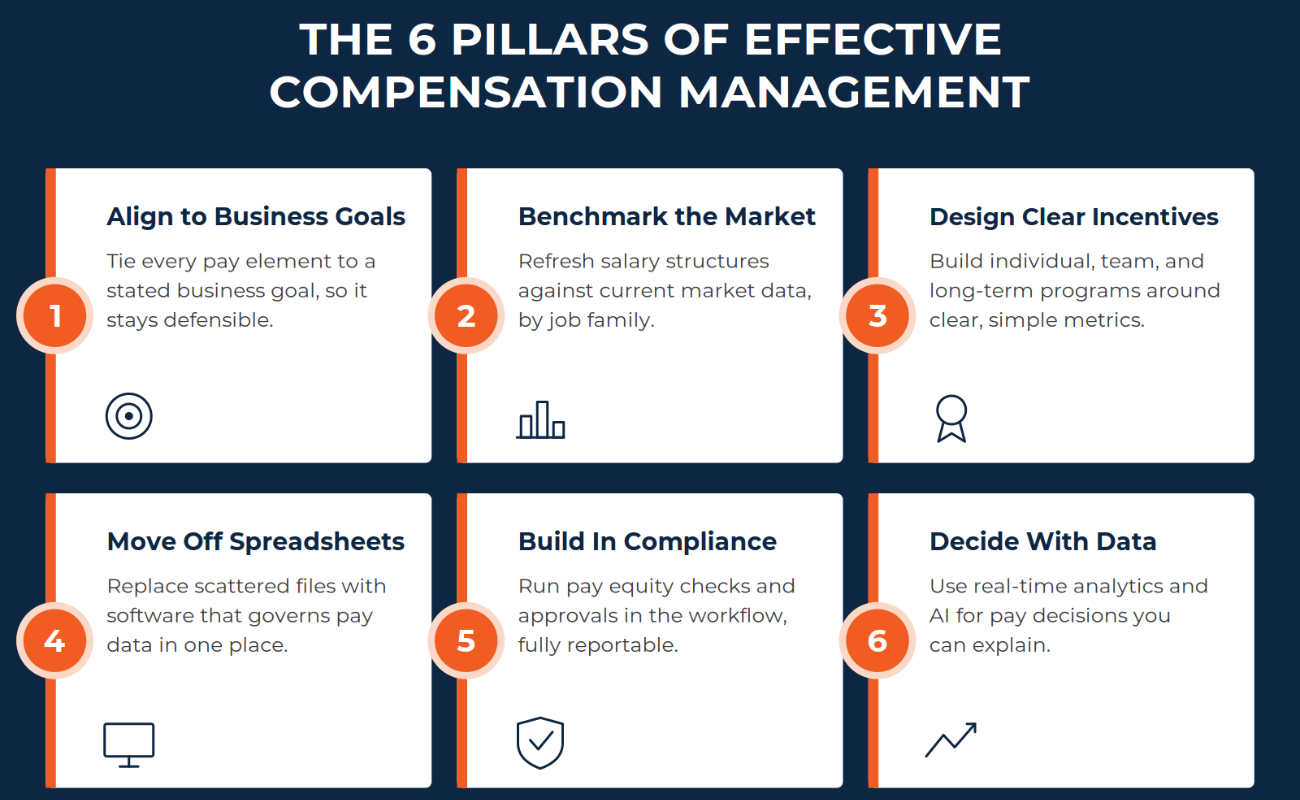
Managing pay at enterprise scale comes down to a handful of practices applied consistently. The six that follow each target a specific way compensation programs break down, from strategy that drifts to data scattered across spreadsheets. Work through them in order, or start with whichever gap is costing you the most right now.
Align Compensation Strategy With Business Objectives
A compensation strategy should be able to answer one question in plain language: what behavior are we paying for? If the company’s business goals center on retention, the weight belongs in base salary progression and equity vesting. If growth is the priority, more of the compensation package should sit in variable pay.
Write the strategy down and connect each pay element to a stated organizational goal. When leadership asks why the bonus pool is sized the way it is, the answer should trace directly back to organizational goals rather than to precedent. This is also what keeps compensation decisions defensible when budgets tighten.
Practical Checks
- Map every pay component to a business objective it supports.
- Review the mapping annually against current business objectives, not last year’s.
- Retire pay elements that no longer drive anything measurable.
Benchmark Against Industry Standards and Market Conditions
Pay ranges built three years ago do not reflect today’s market conditions. Salary structures need a refresh cadence, and that refresh should draw on survey data rather than on internal averages that drift over time.
Look at market trends by job family, not just by title. Two roles with the same title can sit in different markets depending on skill scarcity. Compensation trends in engineering rarely move at the same pace as those in accounting, and treating them identically is how companies lose top talent to competitors who priced the role correctly.
Blending third-party benchmark data into your planning process gives you a live view of where your ranges sit against industry standards. Ranges that lag the market create counteroffers. Ranges that overshoot it inflate labor costs without buying a competitive edge.
Design Incentive Programs Around Measurable Outcomes
Incentive programs work when the metric is clear, the payout math is transparent, and the timing is credible. They fail when employees cannot calculate what they earned.
Individual Incentives
Individual awards pay against defined standards, usually tied to performance ratings or personal targets. They reward high performers directly and give everyone else a visible path to the same outcome. The link to performance management has to be tight, or the awards look arbitrary.
Team Incentives
Team awards tie payout to shared operational metrics. They encourage collaboration and pull a group toward the same target, which is useful when outcomes depend on handoffs between functions rather than individual heroics.
Long-Term Incentives
A long-term incentive plan asks senior leaders to hit multi-year performance conditions before an award vests. Stock options, restricted shares, performance units, and carried interest all fall in this category. These plans carry the most administrative weight because vesting schedules, forfeiture rules, and clawback terms all have to be tracked accurately across years. Long-term incentive plans and sales commission plans both benefit from being administered in the same system as merit and bonus, so nothing is reconciled twice.
Retire the Spreadsheet
Spreadsheets are still the default at plenty of large enterprises, and they are the single largest source of compensation risk. They break in three predictable ways:
- Accuracy. Formula and reference errors are common and hard to spot in files with thousands of rows.
- Security. Emailing pay files moves confidential employee compensation data through channels no one controls.
- Speed. Rebuilding a model after a budget change costs days that the planning calendar does not have.
Compensation management software fixes the structural problem, which is that pay data lives in dozens of copies instead of one governed record. Modern software solutions centralize the data, apply approval workflows, and produce an audit trail automatically. Administration controls determine exactly who sees what, and employee self-service removes the reporting requests that pile up on HR during cycle season.
Build Compliance and Pay Equity Into the Process
Pay transparency legislation and labor laws now vary widely by jurisdiction, and enterprise employers are expected to keep current with all of them. Compliance is easier when the controls sit inside the planning workflow rather than in a review at the end.
- Run pay equity analysis during planning, while adjustments still cost nothing to make.
- Keep a reportable record of every approval, override, and exception.
- Track regulatory requirements by location, including multi-currency pay for global teams.
Clawback provisions belong in this same category. A clawback clause lets the company recover incentive pay if performance conditions were misstated, an employee departs early, or misconduct surfaces. Publicly traded companies operate under SEC recovery rules, and the provision only works if the underlying award data was tracked accurately from the start.

Use Analytics and AI for Data-Driven Decisions
Good compensation data turns pay decisions from opinion into evidence, and compensation planning gets faster when the numbers are already trusted. Reporting and analytics that update in real time let leaders see budget consumption, distribution by group, and equity gaps while the cycle is still open instead of after the numbers are locked.
Artificial intelligence extends that further. Predictive compensation models can recommend awards that fit policy, budget, and performance context, and Compose AI answers questions about your own data conversationally. The point is faster data-driven decisions with the reasoning visible, so a manager can explain any recommendation to an employee.
Clear communication closes the loop. Total rewards statements show employees the full value of their package, which supports talent retention far better than a single number on a payslip.
Align Your Compensation Strategy With Business Goals
Enterprise compensation management rewards discipline more than complexity. Tie your compensation strategy to business goals, refresh salary structures against real market data, design incentive programs people can understand, govern the data in one place, and make compliance part of the workflow instead of an afterthought. Companies that do this attract top talent, protect margins, and spend less time reconciling numbers.
Decusoft Compose was built for exactly this work. It handles merit, bonus, commission, equity, deferred pay, and carried interest in one configurable platform, with the analytics, controls, and AI-powered intelligence that compensation, HR, and finance leaders rely on to run a defensible compensation program.
See what better compensation planning could save your team with our compensation savings calculator, or request a demo to see Compose applied to your own plans.