Employee compensation represents the single largest operating expense for most organizations. According to the U.S. Bureau of Labor Statistics, labor costs can account for as much as 70% of total business costs. With this level of investment at stake, compensation decisions require a strategic, structured approach.
The compensation planning and management process involves assessing your business and budgets, the market, and balancing priorities across your organization. It should be a recurring process to remain competitive and retain your employees. Building and executing on an effective comp plan takes an analysis of your current program and aligning it to your goals before deploying it to your employees.
What You Need to Know About Compensation and Compensation Planning
Compensation is what employees receive from an employer in exchange for their work. It includes both direct and indirect elements and can include any combination of:
- Base salaries
- Overtime pay
- Bonuses
- Commission
- Benefits like insurance, pension plans, or parental leave
- Equity and Stock Options
- Profit Sharing
- PTO
- Non-cash rewards
- Stipends
Compensation planning is the process of designing, implementing, and managing how your organization will pay its employees and, in turn, meet business goals.
Most organizations conduct compensation planning annually, though many review and adjust their strategies more frequently in response to market shifts, business performance, or competitive pressures. When done well, this process transforms compensation from a reactive administrative task into a tool that drives business forward.
7 Steps to Managing Compensation Planning
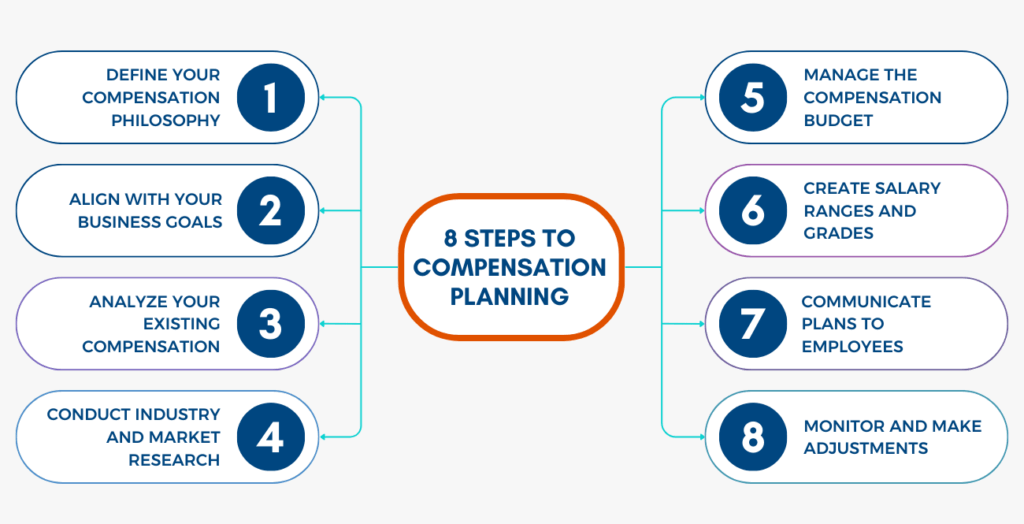
1. Review Your Compensation Philosophy
A compensation philosophy outlines your approach to your employees’ pay. It should provide the framework of every compensation decision that follows, and it’s going to depend on your business culture and current stage. It will evolve are your business does. Revisit it regularly to ensure it still reflects your culture, priorities, and talent strategy.
Ask yourself:
- Has your organization shifted focus (i.e., from growth to profitability)?
- Are you competing for different types of talent than you were a year ago?
- How are your employees motivated: through financial incentives, growth opportunities, stability, or flexibility?
- Are you rewarding top performers in a way that aligns with your organizational goals?
If your philosophy no longer aligns with where the business is headed, your compensation decisions won’t either. Use this as an opportunity to confirm or refine the foundation that guides all your pay decisions.
2. Align To Business Goals
The most effective compensation plans reflect and reinforce organizational strategy. Identify what matters most to your organization:
- Is growth the priority? Your plan might emphasize competitive offers to support talent acquisition.
- Is retention the focus? Merit increases and internal equity may take precedence.
- Are you managing through a period of uncertainty? Budget control and flexibility might be key.
Business priorities shift and your compensation strategy should shift with them. What mattered most last year might not be the focus today.
When compensation strategy and business strategy are aligned, it becomes a tool for achieving results rather than just an expense to manage.
3. Analyze Internal Compensation Data
Conduct a regular audit of your internal pay practices. Look for:
- Are compression issues developing?
- Have pay equity gaps emerged across demographics or departments?
- Which roles are experiencing turnover, and could compensation be a contributing factor?
- Are your salary structures still relevant and accurate?
- Are there clear growth paths for all employees, or do you need to incorporate workforce planning?
Compare your current state against your compensation philosophy and business goals. This ongoing analysis helps you catch problems early and identify where adjustments are needed before they become systemic issues.
Now that you’ve defined your compensation philosophy and identified your business goals, assess whether your current pay practices actually reflect them.
4. Stay Up to Date on Industry and Market Research
Market rates don’t stay static, and neither should your benchmarks. Regularly refresh your market data to ensure your compensation remains competitive within your industry and geographic regions.
Make sure you’re paying attention to salary increases in roles and changes in the median salaries across your competitors. Beyond salary numbers, how do your benefits, bonus structures, and equity offerings compare? A lower base salary might be competitive if your total compensation package is strong in other areas.
Tools like Decusoft’s Predictive Compensation can streamline this process by analyzing market data with your internal compensation and performance data. It fills gaps using real-time publicly available sources like industry salary reports and government databases, helping you benchmark more accurately without the manual research burden.
5. Evaluate The Compensation Budget
Review how your compensation spend is tracking against budget. Are you overspending in certain areas and underspending in others? Did your assumptions from the beginning of the cycle hold, or have market conditions or business needs changed?
Use this review to determine whether budget reallocations are needed and to inform planning for the next cycle. The goal is to ensure your compensation dollars are being deployed where they have the greatest impact.
6. Communicate Compensation Plans to Employees
A compensation plan only succeeds if employees understand it and feel it accurately represents their work. Transparency about how pay decisions are made, what factors influence increases, and how total rewards add up builds trust and employee engagement. With pay transparency legislation expanding across states, clear communication is increasingly both a best practice and a compliance requirement.
At a minimum, employees should understand their salary, any variable compensation, and benefits. But a more complete picture, often called a Total Rewards Statement, can include retirement contributions, healthcare value, equity, lifestyle benefits, and other perks. When employees see the full scope of their compensation, they’re more likely to recognize and appreciate their total value to the organization.
Tools like Decusoft’s Employee Communication feature can automate and customize this process, generating dynamic total rewards statements that give employees a complete breakdown of their compensation. Statements can be branded, personalized with charts and visuals, and delivered through multiple channels, reducing human resources workload while improving the employee experience.
7. Operationalize Your Compensation Plan
A compensation plan is only as effective as its execution. Once you’ve built your structure, the real work begins: putting it into practice and managing it on an ongoing basis.
Build regular review cycles into your operations. Compensation management is not a one-time project. Market conditions shift, roles evolve, and business priorities change. Set a cadence for reviewing internal pay data against market benchmarks, assessing pay equity across the organization, and evaluating whether your compensation spend is delivering the intended results.
A purpose-built platform like Decusoft Compose can simplify this ongoing management. Compose centralizes your compensation data, automates approval workflows, and provides real-time reporting and analytics so you can track budget allocations, monitor pay equity, and make informed adjustments without the administrative burden of spreadsheets. With configurable dashboards and built-in alerts, your team can focus on strategy while the platform handles the operational complexity.
Moving Beyond Spreadsheets
Compensation planning has become too complex for spreadsheets and disconnected systems. As organizations grow, manual processes create administrative burdens, errors become more common, and visibility into compensation data suffers. Without integrated reporting and analytics, answering fundamental questions about market positioning, pay equity, or the true cost of proposed increases becomes difficult and time-consuming.
Purpose-built compensation management software addresses these challenges. Instead of managing data across multiple spreadsheets, HR professionals and finance leaders gain a centralized platform that brings together real-time data, workflows, and insights in one secure environment. The right solution reduces administrative burden through automation, simplifies complex processes with configurable workflows, and delivers the reporting and analytics needed for informed decision-making. It provides visibility into compensation across the organization, supports pay equity analysis, and creates an auditable record of all decisions.
Tools like Decusoft’s Predictive Compensation take this a step further. Powered by AI, it synthesizes your compensation and performance data alongside market benchmarks to deliver personalized salary recommendations with clear, explainable reasoning. Instead of manually researching market rates and building complex models, your team receives actionable insights that align with your compensation philosophy and business goals.
Most importantly, purpose-built software enables teams to focus on strategy rather than data management, transforming compensation from an administrative burden into a competitive advantage.
Why Ongoing Compensation Management Matters

Compensation packages are among the highest priorities for your employees. How you manage compensation on an ongoing basis directly impacts employee retention, recruitment, compliance, and overall business performance.
Manage Your Largest Expense
For most organizations, compensation is the biggest line item on the budget. Without ongoing oversight, inefficiencies add up quickly. Market rates shift, roles evolve, and what was competitive two years ago may no longer be. Real-time data and effective compensation management ensure you’re continuously evaluating where your money is going, identifying overspend, and reallocating resources to the roles and people that drive the most value.
Reduce Turnover Costs
Employee replacement is expensive. Research from Gallup indicates that replacing a single employee can cost between 1.5 to 2 times their annual salary, depending on role and seniority. For a 100-person company with an average salary of $50,000, high turnover can translate to millions in annual replacement costs. Ongoing compensation management helps you identify retention risks before they become resignations, ensuring your pay practices stay competitive and your best people stay with you.
Attract the Right Talent
Candidates often first evaluate the complete package: benefits, flexibility, equity, and growth opportunities. Organizations with clear, competitive compensation structures have a distinct advantage in recruiting, particularly for specialized or hard-to-fill roles.
Effective compensation plans help your talent acquisition. Different types of candidates prioritize different things. According to Deloitte’s 2025 Global Gen Z and Millennial Survey, Gen Z workers prioritize work-life balance over climbing the corporate ladder, with only 6% saying their primary career goal is to reach a leadership position. For these candidates, flexibility, mental health support, and meaningful work may outweigh a higher base salary. In contrast, sales professionals often expect commission-heavy structures where earning potential is tied directly to performance.
Understanding what motivates candidates in your industry allows you to tailor compensation packages that attract the people who will thrive in your organization.
Promote Pay Equity and Compliance
Without ongoing management, pay decisions often become inconsistent over time. Employees in similar roles end up with different salaries based on when they were hired or who negotiated harder. This leads to compression issues, where newer employees earn as much as or more than tenured staff, and potential pay equity gaps across demographics. Compensation planning establishes a defensible structure that promotes fairness, reduces legal exposure, and ensures decisions can be explained and justified.
Meet Business Goals
A business is only as strong as its people, and how you compensate employees directly influences how they perform. Ongoing compensation management connects individual rewards to organizational outcomes. It gives you the tools to motivate employees in different ways, whether through base salary, performance bonuses, equity, or non-cash rewards. When employees understand how their work impacts their compensation and how that compensation supports company objectives, the result is stronger alignment, productivity, and engagement.
Take the Next Step

Decusoft Compose helps human resources, finance, and business leaders design, manage, and deliver pay programs with confidence. The platform combines automation, analytics, and AI-powered intelligence to streamline the entire compensation cycle.
Request a demo to see how Decusoft can help you create and manage a comprehensive compensation plan.