Short answer: A total rewards strategy aims to address all of employees’ needs to create a compensation framework that keeps them motivated and satisfied working at the company. It combines compensation, employee benefits, recognition, development, and flexibility into a single framework that drives employee retention and supports company goals. The key to long-term success is treating it as a living system that scales with your organization and adapts to evolving workforce expectations and regulatory requirements.
For HR professionals and compensation teams managing complex workforce needs, the total rewards conversation has shifted. It’s no longer about whether to adopt a holistic approach to employee value. It’s about how to operationalize and sustain one as your organization scales.
A total rewards philosophy integrates every element of employee compensation and experience (base salary, variable compensation, benefits, recognition, career development, and work-life balance) into a cohesive framework that supports both business strategy and workforce expectations. When executed well, it becomes a competitive differentiator in talent attraction and a driver of long-term retention. When neglected or poorly managed, it creates misalignment that shows up in turnover metrics and employee engagement scores.
Total Rewards Through the Lens of Employee Motivation

The most effective total rewards frameworks acknowledge that employees operate across a range of employee needs. Maslow’s hierarchy of needs offers a useful lens here: compensation addresses physiological and safety needs by enabling employees to afford essentials and plan for the future. Benefits (health insurance, retirement plans, disability coverage) reinforce that sense of security.
But the hierarchy extends further. Recognition programs and career development opportunities address esteem and self-actualization needs, the drivers that keep high performers engaged long after competitive compensation has become table stakes. Recently, the market is seeing young employees prioritize these needs over traditional benefits.
WorldatWork’s total rewards model maps directly to this framework, identifying five core components: compensation, benefits, well-being, recognition, and development. Organizations that treat these as interconnected rather than siloed budget line items tend to see stronger returns on their investment in people.
For a deeper exploration of how Maslow’s hierarchy applies to compensation design, AIHR’s comprehensive guide offers a detailed breakdown.
Why Total Rewards Demands Strategic Attention Now
Pay transparency legislation is accelerating.
Approximately 15 states now have pay transparency laws, with more pending. The share of U.S. job postings including pay information has risen from roughly 15% before 2018 to over 53% since early 2023. Pay structures that once lived in spreadsheets now face public scrutiny, and inconsistencies between posted ranges and actual offers create both trust issues and legal exposure.
Employee expectations have permanently shifted.
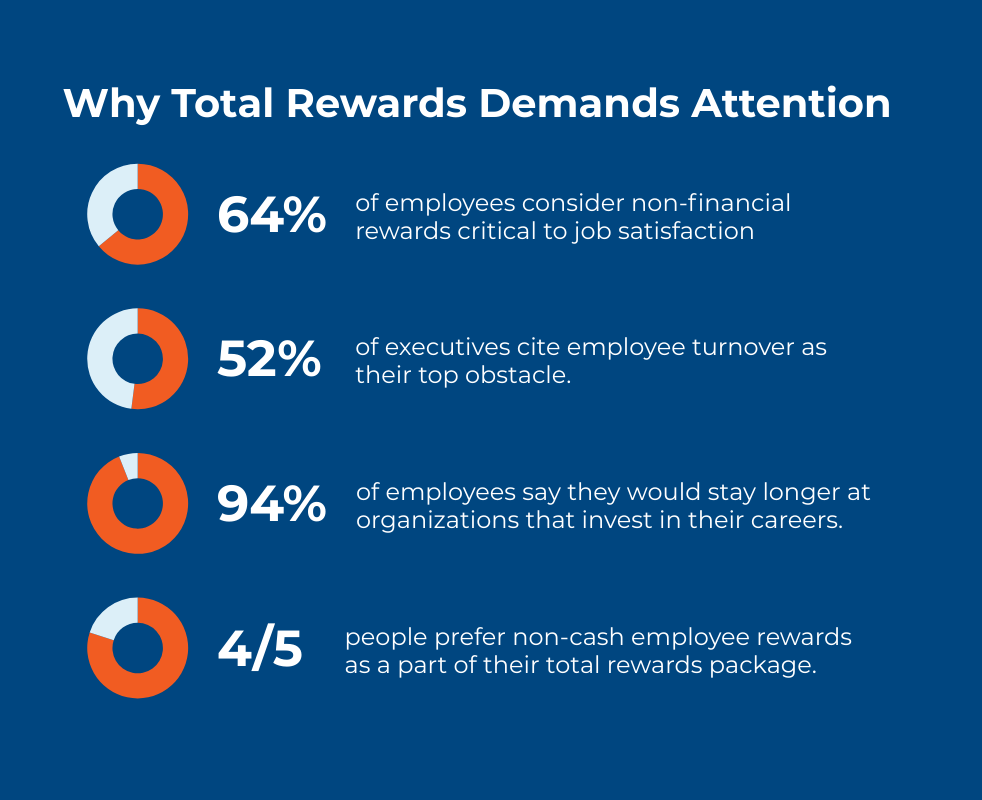
Studies show that 64% of employees consider non-financial rewards (flexible hours, well-being support, development opportunities) critical to their job satisfaction, and 94% would stay longer at organizations that invested in their careers. A study by Northstar Meetings group found that ⅘ people would prefer non-cash employee rewards as a part of their “total award experience”.
Retention remains the dominant workforce challenge.
According to recent workforce trends research, 66% of HR leaders still cite retention as their primary concern, with more than half (52%) of financial executives now listing turnover as their top obstacle. The solution isn’t simply paying more.
Total rewards programs that address development, recognition, and flexibility alongside financial incentives consistently outperform compensation-only approaches on retention metrics.
The Components of a Modern Total Rewards Program

While the specific mix varies by industry, workforce demographics, and organizational culture, effective total rewards programs typically include:
Base and variable compensation – This includes salary, bonuses, commissions, and equity where applicable. The key is ensuring structures are competitive, internally equitable, and transparent enough to withstand scrutiny under current disclosure requirements. A clearly articulated compensation philosophy helps guide these decisions consistently across the organization.
Benefits packages – Traditional medical and retirement plans are no longer the norm. Organizations are increasingly offering mental health resources, family-forming benefits, financial wellness programs, and lifestyle spending accounts that allow employees to direct funds toward what matters most to them. Recent survey data found that health-related benefits remain the top priority for 88% of employers, with leave benefits and retirement planning tied for second.
Recognition and career development – Recognition is on the higher-order needs from Maslow’s hierarchy that drive discretionary effort. This includes formal recognition programs, promotion pathways, mentorship opportunities, and access to skill development. Establishing clear career paths signals investment in employees’ futures. Deloitte found that learning and development ranks among the top three reasons younger workers choose their employers.
Work-life flexibility – This has become non-negotiable for many employees, even outranking pay for recent job seekers. Hybrid and remote work options, flexible scheduling, and paid time off policies signal that an organization trusts its workforce and values outcomes over presence.
When to Reevaluate Your Total Rewards Strategy
Total rewards isn’t a set-it-and-forget-it exercise. The organizations that extract the most value from their reward program treat it as a living system that requires regular assessment and adjustment.
Trigger events that warrant a comprehensive review include:
- Significant changes in headcount or organizational structure
- Merger and acquisition activity
- Entry into new geographic markets with different regulatory requirements
- Shifts in competitive positioning for key talent segments
- Notable changes in turnover patterns or engagement survey results
Ongoing monitoring should track:
- Utilization rates for voluntary benefits
- Employee feedback on specific program elements
- Market movement in compensation benchmarks
- Changes in the regulatory landscape affecting pay transparency or benefits requirements
Building for Scale and Sustainability

The challenge for growing organizations isn’t just designing an attractive total rewards package. It’s maintaining consistency and fairness as the company scales. What works at 20 employees often breaks down at even 100.
Manual processes that seemed manageable become sources of error and inequity. Spreadsheets that tracked compensation decisions become audit liabilities when pay transparency laws require documentation and consistency.
This is where total rewards best practices become critical. Organizations need systems that can maintain compensation structures across multiple locations and regulatory environments, support consistent decision-making in merit and promotion cycles, generate the documentation required for pay transparency compliance, and provide visibility into how total rewards investments are performing against retention and engagement metrics.
Simplify Compensation Management With Decusoft Compose
Managing a total rewards strategy at scale requires more than good intentions. It requires the right infrastructure. Decusoft Compose gives compensation teams a centralized platform to design, manage, and communicate total rewards programs with the consistency and transparency today’s workforce expects.
From compensation planning and pay equity analysis to generating total rewards statements that help employees understand their complete package, Compose helps organizations move beyond spreadsheets and manual processes to a more strategic approach to compensation management.
Reach out to our team for a demo today!